Deploying Passive Bioacoustic Sensors in Remote Sanctuaries
Visual census techniques frequently undercount shy, nocturnal, or canopy-dwelling wildlife. Passive Acoustic Monitoring (PAM) records the undisturbed natural symphony of wild habitats continuously across months.
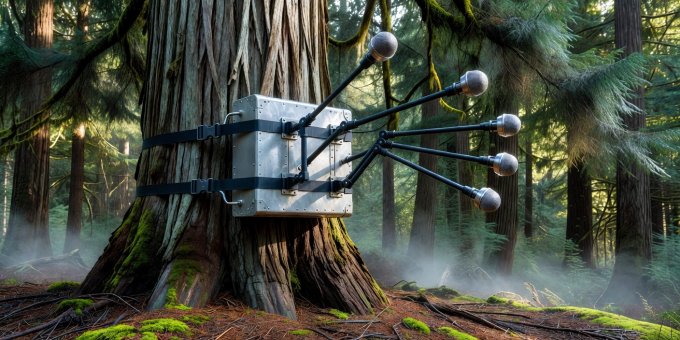
Hardware Rigging and Weatherproofing
Deploying high-gain omnidirectional microphones into temperate rainforests and alpine belts presents distinct technical challenges. Sensor units must withstand sub-zero winters, intense solar UV radiation, and severe moisture saturation.
Our standard sensor pod utilizes an IP67-rated casing with a high-permeability Gore acoustic vent, protecting microphone elements while maintaining uninhibited acoustic sensitivity between 10 Hz and 96 kHz. Ultrasonic sampling enables simultaneous capture of mammalian calls and chiropteran echolocation passes.
Acoustic Indices: Evaluating Soundscape Health
Beyond individual vocalization detection, bioacoustic researchers measure systemic acoustic energy distribution across frequencies. A healthy primary forest features a complex biophony where diverse avian, insect, and amphibian species partition vocal bandwidth to avoid interfering with each other's calls.
| Index Metric | Frequency Range | Ecological Meaning | Threshold for Virgin Habitat |
|---|---|---|---|
| Bioacoustic Index (BI) | 2 kHz – 8 kHz | Avian community richness and breeding intensity | > 6.5 |
| Acoustic Complexity Index (ACI) | 1 kHz – 24 kHz | Structural complexity of biotic sound signals | > 0.42 |
| Normalized Difference (NDSI) | 1 kHz – 11 kHz | Ratio of biophony (life) vs anthrophony (engine noise) | > 0.85 (Minimal Human Noise) |
Automated Machine Learning Call Recognition
Deploying 30 PAM units over a 90-day seasonal window generates tens of thousands of audio hours. Manual human audition is physically unfeasible. We apply convolutional neural network models (CNNs) trained on regional vocal libraries.
The algorithm converts raw .WAV waveforms into visual spectrograms, processing frequency harmonics like an image. This enables rapid extraction of rare, cryptic species presence—such as the Northern Goshawk (Accipiter gentilis) or Boreal Owl (Aegolius funereus)—providing indisputable legal evidence to oppose destructive commercial clear-cutting.

Corridor Verification via Acoustic Stream Mapping
By arranging bioacoustic sensors linearly along newly engineered wildlife crossings and riparian channels, we monitor when migratory fauna begin utilizing new vegetative cover. Increased nocturnal dawn-chorus complexity signals structural vegetation maturation long before large game species adopt the corridor.